The cases at Bristol crown court
were formally dropped against two of the men yesterday and a similar
ruling will be made for the nine others next week,
has
learnt. Fifteen paintings and jewellery worth £1 million were stolen
from the Somerset home of Esmond Bulmer and his wife, Susie, while
Deborah
Barnjum, the couple's housesitter who was tied to a banister, said the
three balaclava-clad burglars were of slight build and had Northern
Irish accents.
As part of the investigation a questionnaire was
sent to builders helping to renovate the house, asking if they knew of
any incriminating evidence.
Avon
and Somerset police arrested and charged three men in 2016. One was a
6ft 5in Asian with a Birmingham accent and the two others were tall,
thick-set men with Gloucestershire accents.
The police tried to
link them to the burglary through phone records. Judge Julian Lambert
stopped the trial last year and ruled that there was not enough evidence
to convict them. The Crown Prosecution Service took the case to the
Court of Appeal, which agreed with the original judgment. The CPS
persisted with new charges. A new prosecutor brought in to review the
case said that it should be dropped.
Charles Hill, a leading art
theft investigator, said that the police investigation was “madness”. Mr
Hill, who recovered Edvard Munch’s
The Scream after it was
stolen from an Oslo gallery in 1994, said: “The housesitter said the
burglars were small, Irish-voiced men. She went through a horrific
experience and was very brave in giving her evidence, but the police
were so convinced through their algorithms on telephone call data,
without knowing what was said in those calls, that they decided to lay a
case against these men.
“The number of competent and able
detectives has dwindled and they don’t appear to have any in Avon and
Somerset. It all boils down to a lack of judgment.”
In February
2015 Mr Bulmer was contacted by Donald Maliska and Jonathan Rees,
private investigators, who organised the paintings’ return for £175,000,
with guidance from Mr Hill and the full knowledge of the police. At one
point the burglars threatened to sell one of the paintings to an
oligarch.
Both men were later charged with conspiracy to receive
stolen goods and defraud an insurance company. Mr Rees had all charges
against him withdrawn yesterday and the case against Mr Maliska will
also be dropped.
A CPS spokesman said that the case was withdrawn
“after serious and extensive review”. Avon and Somerset police accepted
the ruling.
Kieran Galvin, for the defence, said that the case
was a “scandal”. He added: “It is almost impossible to describe to
people that a man who has gone out of his way to get these paintings
back and given them back to the police was then turned on and
prosecuted. The whole thing is just insane.
“Mr Rees acted
properly at all times, took legal advice and liaised with former senior
police officers and recovered very valuable paintings that are not just
property of Mr Bulmer but the property of the nation,” he said.
Private eye who recovered
Bulmer family’s stolen art painted as a criminal by police
A private
investigator who helped recover 14 stolen masterpieces from the criminal
underworld after six years of police inaction
has described the misery his family endured after being turned on by the
police.
Jonathan
Rees, 63, was one of a small group of private investigators who in 2015 managed
to locate and retrieve £1 million of artworks stolen in a violent raid on the
Bulmers cider family mansion in Somerset in 2009.
Despite
working with the blessing of Avon & Somerset police and Hiscox, the
insurance company, in negotiating the return of the paintings, Mr Rees found
himself being treated as a criminal and was dragged through the courts for the
next four years.
Jonathan
Rees was charged despite negotiating for the recovery of the paintings with the
knowledge of police
The Times revealed this week that the case
against Mr Rees and ten other men alleged to have been involved in
the theft and recovery of the paintings — which included Endymion by the
19th-century artist George Frederic Watts — had been dropped by the Crown
Prosecution Service.
A trial last year was stopped by a judge who declared that
the police evidence was “unacceptably tenuous" and based on “fragments of
suspicion and coincidences”.
Mr Rees,
of Weybridge, Surrey, told The Times: “It has been an absolute misery
for my family. Avon & Somerset are one of the poorest police forces in the
country and I hope someone holds the prosecution to account and asks why they
wasted £1.5 million of taxpayers’ money on this case.”
Mr Rees
described how in 2015, after the Bulmers family insurers offering a £50,000
reward for the paintings, he was contacted by Donald Maliska, a fellow private
investigator, saying he had made contact with people who had access to the
stolen paintings.
Mr
Maliska also had charges of conspiracy to receive stolen goods and conspiracy
to defraud dropped this week.
“We
negotiated on their behalf a reward of £175,000 and throughout it the insurance
company, their lawyers and Avon & Somerset police were involved,” Mr Rees
said.
Mr Rees
described Mr Maliska, a former soldier who spent a year in the SAS reserves, as
the “hero” of the recovery because he arranged the pick-up of the 14 paintings
on his own in a hired van, after being given the co-ordinates of a skip where
he would find them wrapped in bubble wrap.
“Who
meets people you don’t know and picks up several million pounds of paintings by
a skip? It was fraught with risk and danger,” Mr Rees said.
Mr
Maliska handed the paintings to Mr Rees, who took them to a high security
storage building where police officers were waiting.
It took
about four weeks for the police forensics teams and art authenticators to
confirm the paintings were genuine. Hiscox then transferred the £175,000 reward
to a jewellers in Birmingham, where it was converted into gold bars and
dispersed by Mr Rees and Mr Maliska to their unnamed sources.
“A month
or two later, the police knock on my door,” Mr Rees said.
He was
accused of fraudulently inflating the reward during negotiations with the
thieves. A judge threw out the charges and when the CPS took it to the Court of
Appeal the appeal judges said the prosecution had come “nowhere near” providing
enough evidence to support the allegation. The CPS persisted with new charges
but after a new prosecutor reviewed the case he said that all the charges
should be dropped.
Charles
Hill, a former detective chief inspector and the world’s leading art theft
private investigator, said police had forgotten how to deal with informants.
“It’s beyond them now. There is a serious lack of expertise and experience or
willingness to do it,” he said.
“I had
suggested to Avon & Somerset police that they go and talk to Jimmy Johnson,
the head of the crime family in the west of England, and their officers said
‘we can’t do that, we would go to jail’. I went up to Jimmy and had a good
chat, why don’t the police do that? You don’t have to be a corrupt police
officer to talk to people.”
Jewellery
was also stolen in the 2009 burglary
In 2016
the force made several arrests and eventually three men were charged with the
2009 robbery and eight others with either handling stolen goods or defrauding
the insurance company by negotiating the reward for their return. All have now
had the cases against them dropped by the CPS.
Deborah
Barnjum, the housesitter who was tied to a banister during the robbery, said
the three balaclava-clad men were of slight build and had Northern Irish
accents.
Avon and
Somerset police arrested and charged three men in 2016. One was a 6ft 5in Asian
with a Birmingham accent and the two others were tall, thick-set men with
Gloucestershire accents.
A CPS
spokesman said that the case was withdrawn “after serious and extensive
review”. Avon & Somerset police said they accepted the ruling.
Back-story below:
‘Brain dead’
https://thebristolcable.org/2019/05/part-one-the-axe-murder-suspect-a-somerset-tory-cider-baron-bulmer-and-the-botched-police-probe-into-a-2m-art-heist/
At 6.30am on 10 June 2015 private investigator Jonathan Rees received
an intriguing text from Don Maliska, an ex-SAS friend who worked in
private security.
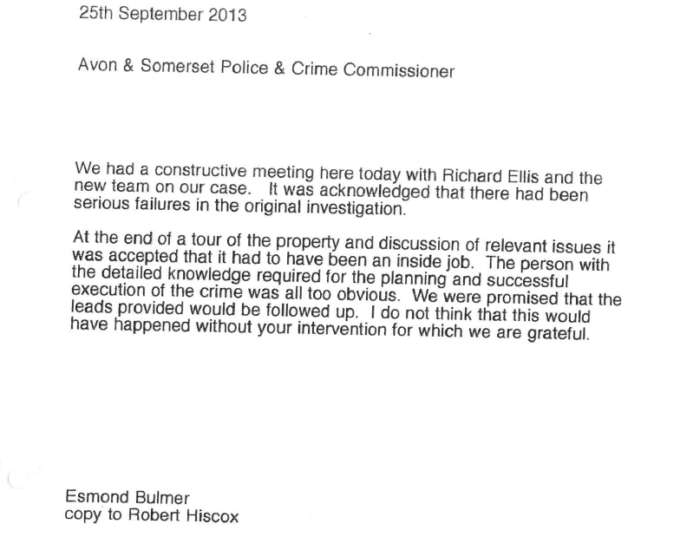
It said: ‘Morning u bastard. Google former Tory MP Esmond Bulmer (Bulmer cider). Art theft.’
Rees complied and learned that six years earlier in March 2009
Bulmer’s Italian-style villa called The Pavilion in Bruton, Somerset had
been robbed while he was on holiday with his wife.
Three men had tied up the house sitter and driven off in the family Mercedes with 15 paintings and jewellery worth over £2m.
Bulmer was incensed by what he saw as Avon & Somerset police’s
‘brain dead’ investigation. The cider baron believed the robbery was an
inside job by a building contractor with links to an organised crime
group in Gloucester.
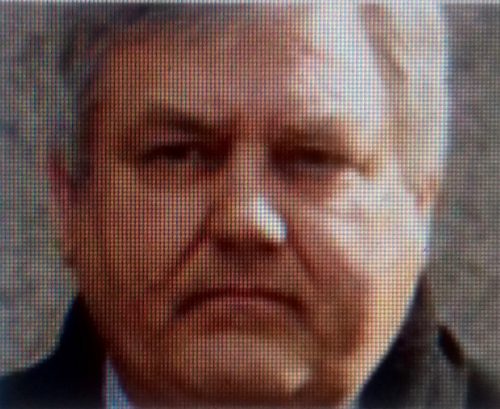
Jonathan Rees
The police disagreed – they thought it was a team from Merseyside who
were after Mrs Bulmer’s jewellery worth over £500,000 – but
nevertheless sent a questionnaire to builders who had worked on
renovating the mansion. Unsurprisingly, none confessed by return post.
The robbery was controversial for another reason. Prince Charles had
just used the same building contractor and workforce for Highgrove, his
Gloucestershire home, so the suggestion of an inside job had royal
security implications.
The police investigation was out of its depth and soon closed down
without results. But Bulmer used his connections to keep ‘a burner under
Avon & Somerset police’. The case was re-opened in 2014 after the
83-year-old, a former parliamentary private secretary at the Home
Office, complained to Theresa May, the then home secretary, and to the
chief constable.
Detectives from the Serious and Organised Crime Group based at police
headquarters in Portishead were given the case but hadn’t got very far
by the summer of 2015 when Rees received the text from his ex-SAS pal.
Maliska had a tip that the Bulmer art collection had been stored for
years but those controlling the fifteen paintings now wanted to off load
them for a reward.
Rees agreed to be Maliska’s intermediary and was given a USB stick
containing photographs of the paintings each taken with a recent copy of
The Sun.
Whoever controlled the stolen art clearly had a sense of humour
because they used the tabloid’s ‘DIAMOND WHEEZERS’ front page on 20 May
announcing the arrest of the elderly gang behind the recent £14m Hatton
Garden safe deposit robbery.
Through a friendly journalist, Rees was introduced to the UK’s
leading art detective. Charley Hill was no dusty academic but a former
Vietnam veteran who had turned his back on the priesthood for a career
in Scotland Yard, where he ended up overseeing its arts and antiques
squad until his retirement in 1997.
During his time in the police, Hill had specialised in posing as an
art dealer and helped recover Munch’s The Scream during one of many
undercover operations.
Now in his late sixties, Hill earns a good living as an art detective
for hire. The approach from Rees intrigued him, especially when Hill
put the private investigator’s name into Google.

Daniel Morgan. Photograph: New Scotland Yard/ PA
Axe murder fells Scotland Yard
The search engine threw up multiple hits naming Rees as the prime
suspect in the 1987 murder of Daniel Morgan, his then partner in a
private investigation agency based in south London.
The Morgan case is the most investigated murder in UK policing
history and still remains unsolved after five investigations costing at
least £50m.
The Metropolitan Police was forced to apologise to the Morgan family
after decades of stonewalling and covering up its incompetence and
corruption.
No clear motive has been proven for Morgan’s murder, but the Met have
claimed the 37-year-old father of two was preparing to blow the whistle
on police corruption and links between London drug dealers and Irish
paramilitaries.
The theory goes that this threatened Rees, who arranged to meet
Morgan at the Golden Lion in Sydenham on the night of 10 March 1987.
Someone later attacked Morgan with an axe in the pub car park, which was
left embedded in his head.
Rees, his two brothers-in-law and other two suspects, including a
former detective sergeant who briefly investigated the murder and then
on retirement joined the private investigation agency, have always
maintained their innocence.
They say other lines of inquiry – for example where Morgan’s
complicated personal and professional life collided – were ignored and
they are scapegoats for massive police incompetence and vindictiveness.
The Morgan family are not convinced but battled alone for 25 years
until sections of the media revived the murder case for its own ends
during the phone hacking scandal in 2011.
After Morgan’s murder, Rees had renamed Southern Investigations and
began working closely for Rupert Murdoch’s News of The World and other
mainly tabloid newspapers.

Morgan’s body was found outside the Golden Lion pub in
Sydenham, South London on March 10, 1987
The lucrative arrangement continued even after Rees was convicted in
2000 for working with a corrupt Met detective to plant drugs on the wife
of a client who was locked in a custody battle.
The 61-year-old former seaman from Yorkshire is viewed by many as a
master of the dark arts with a roster of dirty cops, bent journalists
and other sources at his disposal to hack and blag private information
for scoops on errant celebrities, big crime stories and randy
politicians.
But by the time Rees was involved in recovering the stolen Bulmer art
collection The News of The World had been shut down and he had emerged
as one of the chief villains of Lord Justice Leveson’s inquiry into
media standards.

But Rees refused to go quietly and had become an embarrassing thorn
in the side of the Met who he was suing for malicious prosecution and
misconduct in a public office following his spectacular acquittal for
the murder of Morgan.
The trial of five murder suspects collapsed in March 2011 after the
chief detective leading this fifth investigation was found to have acted
corruptly. The fit up involved coaching supergrasses to implicate Rees
and others in order to improve the chances of conviction.
Responsibility for the collapse of the investigation, however, went
all the way to the top of the Met. And the most powerful force in the UK
was now facing a massive damages claim and, worse still, Theresa May
had ordered an outside inquiry into its handling of the Morgan murder in
2013.
Winston Wolf and the art detectives
None of this put off Charley Hill. The retired detective chief
inspector was a maverick and never blindly loyal to the Met. He jokingly
likened Rees to the fictional character Winston Wolf – the gangland
fixer played by Harvey Keitel in Pulp Fiction.

Charley Hill
Bulmer had contacted Hill immediately after the burglary but the art
detective was too busy and put the cider baron in touch with Dick Ellis,
another veteran of the Met’s arts and antiques squad. After retiring
from the police in 1999, Ellis worked for Christie’s then joined a
Plymouth-based investigation agency before setting up his own
consultancy.
He too believed the initial police investigation was incompetent. But
Ellis discounted the notion that the Johnsons, a notorious family from
Gloucestershire, were responsible. The robbery was ‘a professional job’
not a smash and grab raid, he deduced.
On 17 June, Ellis alerted the insurance firm that had hired him to
investigate the robbery. Hiscox was delighted with the break through
after six years. The insurance firm had already paid out £1.2m to Bulmer
soon after the robbery and felt this was the best chance of recouping
their ‘significant loss’.
Under British law there is a public interest in the recovery of
important works of art. A reward is a necessary part of the recovery
process but cannot be paid to anyone known to be involved in the theft.
Insurers will usually cap the reward at 10% of the stolen item’s
value. Hiscox’s initial reward was £50,000, but this was deemed too low
and the insurers indicated they were willing to go to £150,000.
All but one of the fifteen stolen works of art were on offer, but
emails show Rees and Maliska still hoped the recovery would be worth
somewhere between £200,000 and £300,000.
On 24 June, Ellis and Hill met Rees for dinner at an Italian
restaurant near Waterloo station. ‘They are not stupid people,’ Rees
told the Cable. ‘They did their own fucking Googling. They asked me
about [the Morgan case] and I talked to them about it. I don’t shut up
about the fucking Morgan case. I told them what it was all about and the
other things I’ve been involved in work wise.’

Donald Maliska
Rees had agreed to keep Maliska’s name out of it and told his dinner
guests that he was fronting for ‘SAS boys’ now working in private
security who needed to remain anonymous because of concern about past
military activities during the dirty war in Northern Ireland.
After the meeting, Ellis told detectives in Portishead that he was
‘satisfied’ Rees was simply ‘a mouthpiece’ for someone who could get to
those controlling the stolen paintings.
The detectives did their own checks on Rees and discovered his extensive and colourful entry on the police national computer.
By July 2015, it was clear to Avon & Somerset police that they
were dealing with a sophisticated fixer and long-term target of the Met
who was offering a way of finally getting Bulmer off their back.
‘A reputational risk’
Negotiations, however, took a dramatic turn on 11 July when Rees
informed Hill that those controlling the paintings were going to sell
Bulmer’s favourite piece to an unnamed Russian oligarch if the reward
was not raised within three days to £175,000.
‘The source phoned up Don [Maliska] and said they’ve got this Russian
who just wants this one painting, Apple Blossom, because it looks like
his 16-year-old daughter who died in a car crash,’ Rees explained to the
Cable.

Stolen Apple Blossom painting, next to a copy of the Sun newspaper
Hill immediately thought the whole thing was ‘a load of bollocks’ – a
ruse to raise the reward. Ellis went further, he thought the reward
negotiations might now have become a ransom, which is illegal to pay,
and raised it at a secret high-level police meeting in Portishead where a
representative of the National Crime Agency’s anti-kidnap and extortion
unit was also present.
Internal documents show Avon & Somerset police were concerned
about ‘the reputational risk’ to the force. Detectives were wary of
Rees. However, the transcript of the meeting shows Ellis referring to
Rees as ‘an honest broker’.
The secret meeting concluded that there was insufficient evidence to
arrest anyone; that Hiscox was responsible for the reward negotiations
and detectives would wait to see if any criminal intelligence emerged
from a successful recovery.
Consequently, the police refused to provide Rees with a ‘comfort
letter’ but did note in one internal document that he had committed ‘no
criminal offences’ and the National Crime Agency agreed the £175,000
reward could be paid into his bank account.
On 11 August, Rees signed an official document drawn up by Hiscox
confirming that he and those he represented were not directly or
indirectly involved in the robbery or handling of stolen goods.
Hiscox agreed to transfer the reward money soon after the handover of
the paintings, which was now set to take place at a secure warehouse
near London Bridge on 20 August.
SAS man revealed
Don Maliska has a lean military bearing. The 64-year-old Scottish
private investigator served nine years in the army during the seventies
including a year attachment to the SAS reserves.
He told the Cable that the Bulmer case was ‘my job, my source’ and
that Rees acted as the intermediary to ensure the recovery was above
board. The Scot and Yorkshireman were friends of twenty years and had
been contractors for The News of The World.
On 19 August, Maliska hired a white van in Essex using his real name
and military ID and early the next morning drove to the Midlands to
collect the paintings.
He returned to London before midday and gave the keys to Rees who
drove the van alone through the gates of the secure warehouse where the
police were waiting.

Don Maliska hiring van to collect art
Forensic officers swabbed the paintings for DNA and dusted for
fingerprints before an art specialist began the authentication process.
Days later, a satisfied Hiscox transferred £175,000 to a jewellers in
Birmingham after Rees decided at the last moment against using his own
bank account.
On 24 August, Maliska travelled with two associates to Birmingham
where the reward money was converted into gold bars and dispersed. Who
got what remains unclear but Rees said he received no share.
Separately, Ellis earned a £58,000 success fee from Hiscox and a
bonus from Bulmer. ‘Expectations with this kind of work are that, you
know, you will earn some money out of it one way or the other,’ he
explained. Ellis paid £5,000 to Hill and £10,000 to Rees, who says he
paid half to Maliska.
Months passed. Everyone appeared happy. Bulmer had his paintings and
Hiscox had recovered 60% of what it paid out. Rees was even planning
further art recoveries with Hill, including getting back the cider
baron’s missing Afterglow Taplow by Sir John Lavery.
Then, on 17 May 2016 everything changed. Rees, Maliska and ten others
were arrested for offences connected to the robbery and recovery.
In nine months, Avon & Somerset police had gone from taking a
cautious back seat over ‘an entirely private arrangement’ to a full on
proactive operation codenamed Shine.
Had the detectives been running a sting operation all along? Or, as
Rees and Maliska now suspected, did the explanation for the change in
gear lie in London with the scandal engulfing the Met over the Daniel
Morgan murder?
A Big Secret
https://thebristolcable.org/2019/05/part-2-the-troubled-cop-bent-on-solving-the-uks-longest-running-murder-case-and-a-key-player-in-the-phone-hacking-scandal/
To murder someone with an axe is unusual. It’s certainly not the
preferred weapon of a contract killer, but more like something a violent
thief might use. Yet Daniel Morgan was not robbed. He was found dead in
the Golden Lion pub car park in March 1987 with an axe in his skull and
£1000 in his pocket.
An axe might also fit happily into the hand of an insanely jealous
lover or cuckolded husband blindly driven by murderous rage. Crimes of
passion often leave forensic clues. Yet the axe that killed Morgan, a
37-year-old father of two young children, was specially woven with grip
tape to ensure maximum leverage and no usable fingerprints or DNA.
What, then, if the person or persons responsible for the murder were
not professional killers but needed to silence the private detective and
had used an axe to put the police off the scent?
In detective chief superintendent David Cook, the Morgan family had
finally found someone in the Metropolitan police they trusted to address
these questions and solve the brutal murder, however embarrassing it
was for the top brass.

David Cook. Photograph: Stefan Rousseau/ PA
When Cook took over the case in 2003, the stench of corruption,
incompetence and masonic influence was undeniable, despite the Met’s
best efforts for years to do just that.
Already, there had been four failed investigations into the same five
suspects – Jonathan Rees, Morgan’s business partner, Glenn and Garry
Vian, Rees’ brothers-in-law (the former said to be the axeman), Jimmy
Cook, the suspected getaway driver, and Sid Fillery, a former detective
sergeant who briefly investigated the murder and on his retirement
became Rees’ new business partner.
The motive for the murder lacks clarity but the Met eventually
settled on claims by witnesses that Morgan was preparing to blow the
whistle on police corruption. How that concerned Rees and his circle is
less clear, but where bent cops tread gangsters are not far behind and
the Met threw in the possibility of links to drug dealing Irish
paramilitaries.
Rees and the other usual suspects have consistently denied any
involvement in the murder and say that from the outset detectives failed
to examine alternative theories and motives. They point to Morgan’s
adulterous private life and his at times dangerous work as a repo man
and server of court summonses, which put him in the cross hairs of
violent people here and abroad.
But the Met continued to insist they had the right men, who were
bugged, tapped and infiltrated with a spy, all, however, to no avail.
The hundreds of hours of secret recordings yielded no clear admissions
and no forensics to justify a prosecution for murder.
It was not all failure, though. Rees was jailed for seven years in
2000 after bugs in his private investigation firm, renamed Law &
Commercial, caught him plotting to plant drugs on the wife of a client
locked in a custody battle.
In 2003, Fillery pleaded guilty to accessing indecent thumbnail
images of children on his computer. And two years later, Garry Vian was
jailed for fourteen years for his part in a major drug importation.
Despite these mini victories, by 2005, most senior detectives would
have turned down the offer to lead a fifth murder investigation. The
Morgan case was a poisoned chalice, akin to career suicide.
But Cook was flattered by the approach. He promised not to let down
the long-suffering Morgan family, whose campaign for justice had almost
hollowed out Daniel’s older brother.
But it was false hope, because David Cook was hiding a big secret;
one that would drive him to act corruptly and plunge the Met into a
massive crisis.
The Supergrass Farce
The Morgan family understood from Cook that a successful prosecution
needed witnesses to the murder, which was unlikely, or at least to its
cover up – people to whom the usual suspects had perhaps confessed or
tried to recruit.
Such witnesses were likely to be criminals and would therefore have
to be debriefed carefully before they were presented to a court as
credible. This would mean admitting all their crimes in return for a
reduced sentence, witness protection and in some cases a salary – a
process known as ‘cleansing’.
However, the use of supergrass witnesses had been wholly discredited
by the time Cook took over the case. Between 1994 and 2002, the Met’s
anti-corruption squad of so-called Untouchables had coached and induced
supergrass evidence against allegedly bent cops and hidden this from the
court. Inevitably, prosecutions collapsed or were overturned on appeal
at the cost of millions to the taxpayer, and undoubtedly some dirty cops
walked free.
Assistant commissioner John Yates, the officer to whom Cook now
reported, was a former Untouchable. He had overseen a discredited
supergrass-led operation against a ‘Groovy gang’ of allegedly corrupt,
drug dealing southeast London detectives linked to the Rees circle.
Jonathan Rees
One of the supergrasses, a repentant detective in the Groovy gang, claimed
his other allegations about a bent officer on the Stephen Lawrence murder inquiry were suppressed to protect the Met.
Though he denied the claim, Yates was definitely not someone who had
the Morgan family’s trust. Not least because after the failed fourth
investigation he had presented a whitewashing report that the
Metropolitan Police Authority rejected.
The family was understandably suspicious when just as their call for a
judicial inquiry into the whole Morgan mess was gathering pace among
politicians, Yates appeared in 2006 with news of a major breakthrough in
the case.
A witness had come forward, he said, who might prove to be the
‘golden thread’ needed to bring a successful prosecution for murder
against Rees and the others.
Over the next two years, Cook had many undocumented conversations
with several slippery criminals while they were going through the
debriefing process. These supergrasses went on to variously claim that
the suspects had confessed details of the murder and in one case that he
was present in the pub car park when it happened.
Then in late 2008, Rees, the Vian brothers and Jimmy Cook were
arrested for involvement in the killing and Fillery for perverting the
course of justice.

Daniel Morgan. Photograph: New Scotland Yard/ PA
However, months of legal argument at the Old Bailey slowly chipped
away at the prosecution case as one by one the judge excluded the
unreliable evidence of the key supergrasses. More importantly, Cook was
exposed for having coached two of the most important witnesses, one of
whom had a narcissistic personality disorder making him prone to
pointless lying and manipulation.
Like a master of ceremonies in a game of Cluedo, Cook had told the
witnesses what evidence he wanted to hear – it was Glenn Vian with an
axe in the pub car park – and the supergrasses obliged.
In March 2011, on the twenty-fourth anniversary of the Morgan murder,
the prosecution threw in the towel and the judge found that Cook had
effectively perverted the course of justice in trying to secure
convictions.
The Morgan family were devastated and refused to stand with Yates
while a statement was read outside court. Four months later, in July
2011,
he resigned
as another unfolding scandal – phone hacking – exposed the cosy
revolving door between the Met and Rupert Murdoch’s News of The World.
In a letter to the Morgan family Yates said, “What I do hope though
is that you understand that David Cook and I tried our very best.”

Illustration: Rosie Carmichael
Hacked Off
In July 2011 Cook went sick. He successfully sued Murdoch and the Met
over an incident that occurred when he first got involved in the Morgan
case.
The News of the World had briefly put him and his police wife, Jacqui
Hames, under surveillance in 2002 when he fronted a Crimewatch appeal
about the Morgan case. Cook believed the intrusion was a favour to Rees
and Fillery, the tabloid’s long-standing dark arts masters, and claimed
it had caused the break up of his marriage.
He also lambasted the Met for failing to relocate his family or
admonish Murdoch executives. Cook rightly suspected they were too close
to senior officers. But in a rare concern for the taxpayer, the Met had
concluded that the threat, which included blagging personal information,
did not merit buying the family home.
The snub helped make Cook and Hames darlings of the Hacked Off lobby
of celebrities, their lawyers and media rivals who were delighted when
prime minister David Cameron invited Lord Leveson to look into press
standards.
But in January 2012, their Hacked Off hero was suddenly arrested,
ironically for leaking information during the Morgan case to Mike
Sullivan, the crime editor of another Murdoch tabloid, The Sun.
Only then, when facing possible prison, did Cook appear to come clean about his big secret.
Death was a predominant thought
In a witness statement to the Independent Police Complaints
Commission (IPCC), who had ordered his arrest, Cook revealed that he was
suicidal throughout his involvement with the Morgan case.
He said his marriage had really broken down in 1999 because of the
effect of the assassination of Jill Dando on his wife, who co-presented
Crimewatch. The estrangement from Jacqui Hames grew after he got
involved with the Morgan case in 2002.
Two years later, Cook said he attempted suicide for the first time
and tried again in 2009, when Hames started divorce proceedings.
‘Everything was against me, so I tried again on at least two maybe three
occasions. Strangely, when I kept failing it just made me worse and on
some occasions more determined … I really cannot remember much about
2009. Fighting the depression and a desire to kill myself was the
predominate thought.’
It was in this acute mental crisis that Cook had cleansed the
supergrasses and prepared for the murder trial of Rees and the others.
But there was still one more secret to reveal.
Yates liked to nurture friendly journalists and had introduced Cook
to Mike Sullivan of The Sun well before the murder trial. In fact, Yates
approved of their plan to collaborate on a favourable book where it was
hoped that Cook would be the hero cop who saved the Met and solved the
case.
‘The book was a dream that I hoped would one day become a reality. At
one point it was perhaps one of the few things that kept me alive …
from 2008/9 there were times when I was not even looking to be alive
when it was all finished,’ Cook wrote in his IPCC statement.
No money changed hands but Cook had financial problems because of his
divorce and knew there was money in a book with a happy ending and ‘a
movie deal’ attached.
It is hard to imagine a more dangerous state of affairs that the Met
had overseen: A mentally unstable senior detective with money problems
had manipulated witnesses in a murder trial while preparing a
hagiography that would be worth more if the defendants were convicted.

Theresa May. Photographer: Arno Mikkor
Damages
In 2013, Theresa May refused the Morgan family’s call for a judicial
inquiry into the long-running fiasco, but instead ordered one by a Home
Office appointed panel.
The Met’s handling of corruption allegations surrounding the Stephen
Lawrence case was already under examination by a Home Office appointed
QC. Both inquiries are still on going and have the potential to
implicate a host of senior retired and serving officers in criminal and
disciplinary offences.
In 2015, however, the IPCC decided it would not be in the public
interest to prosecute Cook for the leaks to The Sun – because he had
retired.
The watchdog never disclosed Cook’s witness statement to lawyers
representing Rees, the Vians and Fillery who were now suing the Met for
malicious prosecution and misconduct in a public office. Somehow the
IPCC didn’t think the statement was relevant to Cook’s coaching of
supergrass witnesses.
Equally, the Met had no interest in having Cook prosecuted for
perverting the course of justice. A source close to the retired officer
said he had warned the Met he would not go quietly if charged.
Clearly Cook has an important story to tell about what happened
inside the Met and Morgan investigation, but he declined to speak to the
Cable.

One of the stolen paintings, an Edward Poynter original,
displayed alongside a copy of the Sun newspaper.
Meanwhile, over in Bristol, it was no stone unturned to prosecute
Rees and others for the Bulmer art heist, which had been successfully
recovered in August 2015 for a £175,000 reward.
Avon & Somerset police perhaps had a point to prove that they
were not ‘brain dead’, as Bulmer called the initial investigation into
the 2009 robbery. But the embattled Met was also aware that their
colleagues down the M4 had Rees within their grasp.
Between August 2015 and May 2016 significant resources were poured
into Operation Shine, which was run out of the Portishead headquarters
of the Serious and Organised Crime Unit.
Rees was charged in 2017 with defrauding Bulmer and Hiscox insurance
and perverting the course of justice. The dark arts trial was set for
summer 2018.
‘I can’t believe that if he wasn’t Rees he would have been nicked,’ a
source in his legal team told the Cable. Adding that a conviction in
Bristol would certainly assist the Met over their ongoing Morgan
debacle.
What happened in the witness box would take all sides by surprise.
‘Too hot to handle.’
https://thebristolcable.org/2019/05/part-three-a-somerset-cider-barons-stolen-art-collection-heroin-from-pakistan-two-collapsed-cases-and-a-rinsed-taxpayer/
In late August 2014, a ship from Pakistan docked at the Suffolk port
of Felixstowe. Among the containers was 44 kilos of heroin packed inside
hydraulic presses.
The UK Border Police somehow discovered the drugs and alerted the National Crime Agency (NCA).
The presses were resealed with trackers and surveillance officers
followed the lorry picking up the machinery to a business in Birmingham
where weeks later the gang behind the £5m drug importation were
identified.
Documents seen by the Cable suggest that during the surveillance
operation the NCA picked up intelligence, probably from phone taps and
probes, that some in the heroin gang were trying to offload the stolen
Bulmer art collection because it was ‘too hot to handle.’

The intercepted, heroin-containing machinery/ NCA
This intelligence was passed in October 2014 to Avon & Somerset
police who had only recently reopened the art robbery at the cider
baron’s Somerset mansion following criticism that the initial
investigation by Yeovil police in 2009 was ‘brain dead’.
The former Tory MP had lobbied Theresa May and pressured the chief
constable, who gave the case to Serious and Organised Crime detectives
based at headquarters in Portishead.
The detectives worked closely with Dick Ellis, the former
Metropolitan police officer, who Hiscox Insurance had hired to recover
the Bulmer art collection worth £1.2m.
Ellis was taken into the police’s confidence over the intelligence about the paintings but he was not allowed to share it.
Mark Regan, 43, and Skinder Ali, 36, two of the main players in the
heroin gang, were under surveillance for almost a year before being
remanded to prison in August 2015 to await trial.

Skinder Ali/ NCA
An encrypted phone seized from Ali’s home contained compromising
messages between the drug gang using colourful codenames such as Aquaman
and Shops.
One exchange on 15 June 2015 was particularly interesting. It looked
like someone called Tom was causing trouble but couldn’t be cut loose
because he was ‘the route to the paintings!!!’
Five days earlier, on 10 June, Donald Maliska had contacted Jonathan
Rees about an opportunity to recover the Bulmer art collection. At the
time Hiscox were offering a £50,000 reward if the collection was
returned in good condition.
Maliska had been doing this type of recovery work for insurers and
private individuals since he left the SAS in 1979 and had once taken
back a ship and its crew who were being held hostage by Nigerian
pirates.
Getting back the Bulmer collection seemed easy by comparison and
Maliska recruited two associates and asked Rees to be his intermediary
with Hiscox and the police. They were not to know his real name just
that Rees was representing ‘ex-SAS boys’ who could get back the
paintings.
Rees agreed and was given a USB stick with photographs of the paintings that were taken next to a recent copy of
The Sun.
Between 10 and 15 June, matters moved at an incredible pace. Rees
handed legendary art detective Charley Hill the USB stick. He gave it to
Ellis, his old colleague from the Met’s arts & antiques squad, who
immediately alerted Avon & Somerset police.
Ali’s encrypted phone messages suggested he and Regan were aware meetings were taking place to start the recovery process.
Over June and July, organised crime detectives in Portishead made
enquiries about Rees’ long history with the Met over the Daniel Morgan
case, which at the time was causing the UK’s largest police force major
problems.

Mark Regan/ NCA
Retired detective chief superintendent David Cook,
the suicidal officer who corruptly undermined the fifth investigation, was said to be threatening to bring down others in the police if he was charged with any offences.
Meanwhile, Rees, the Vian brothers and Sid Fillery were suing the Met
for malicious prosecution and misconduct in a public office over Cook’s
actions. And to make matters worse, an independent inquiry ordered by
Theresa May into the whole fiasco was underway.
It was against this background that on 17 July 2015, the NCA and Avon
& Somerset detectives met secretly with Ellis in Portishead to
discuss a demand that Rees had recently communicated from those
controlling the paintings for £175,000.
The meeting ended with an agreement that Hiscox could pay the reward
but detectives would continue to monitor the situation for any leads
about the recovery efforts.
The police now knew Rees’ mobile number, which presented an
opportunity to identify the ‘SAS boys’ and through them those
controlling the paintings.
Whatever contact took place between Avon & Somerset police and
the Met remains a secret because the transcript of the Portishead
meeting was redacted in long sections when Rees was discussed.
Maliska recovered the paintings from the Midlands and Rees handed
them over to the police on 20 August 2015. Four days later, the £175,000
reward was transferred to the bank account of a jeweller in Birmingham
and converted into gold bars.

£50,000 reward poster for paintings
Over the next nine months, detectives in Portishead secretly
cross-referenced intelligence on the heroin gang against what they had
on Rees and Maliska.
The ex-SAS man was easily identified because he had used his real
name to hire a van to collect the paintings. His mobile phone records
were obtained and calls triangulated with others.
By May 2016, Avon & Somerset police felt Operation Shine had
enough evidence of a massive conspiracy to make arrests in London, Kent,
Surrey, Gloucestershire and Birmingham.
Ali was suspected of robbing the Bulmers with two builders, Liam
Judge and Matthew Evans, who had worked on renovating the cider baron’s
mansion.
Ali, Regan and another Birmingham man, Tom Lynch, were suspected of
handling the stolen paintings with Maliska and his two associates David
Price and Ike Obiamiwe.
Rees was suspected of trying to defraud Bulmer and Hiscox insurance
with the three ‘SAS boys’ and separately of perverting the course of
justice by lying in a witness statement about who they were.
Two jewellers from Birmingham were suspected of money laundering by converting the £175,000 reward into gold bars.
Everyone was bailed except Regan and Ali who were in prison awaiting
trial for the heroin importation. In September 2016 they received hefty
sentences of 21 years each.
The Bulmer art theft trial was set to open in summer 2018.
Perverting the course of justice
Meanwhile, back in London, Rees’ nemesis, David Cook, was fairing much better at the hands of the criminal justice system.
The police watchdog decided in November 2015 that though there was
evidence against him, Cook would not face any criminal charges for
leaking documents to
The Sun journalist. Apparently, it wasn’t in the public interest now that he had retired.
A senior Met officer then produced a report that exonerated Cook, and therefore the force, of perverting the course of justice.
But in February 2017, a second senior judge, this time in the high
court, came to the opposite conclusion after hearing the malicious
prosecution claim brought against the Met by Rees, the Vians and
Fillery.
David Cook. Photographer: Stefan Rousseau/ PA
Judge Mitting was not impressed when Cook didn’t appear as a witness
for the Met. The retired officer sent a doctor’s note that it would set
back his mental recovery. But Cook’s witness statement about his
suicidal state of mind while overseeing the fifth murder investigation
had not been disclosed to the defence.
Mitting found that Cook had perverted the course of justice, but
controversially suggested that it was born of a genuine belief that Rees
and the others were guilty.
Mitting, who now chairs the inquiry into undercover policing, also
found that as Cook was not responsible for bringing charges, that was a
decision by the CPS, therefore the malicious prosecution claim must
fail.
Rees and the Vians immediately appealed and were back in front of
three high court judges in April 2018, two months before the Bulmer
trial was due to start in Bristol.
The appeal court in London completely reversed Mitting’s ruling and
found that because Cook had acted corruptly while pushing the
prosecution all the claimants were therefore entitled to compensation.
The decision put renewed pressure on the CPS to finally bring charges against Cook for perverting the course of justice.
Honest brokers
Over in Bristol, Rees and Maliska were in a light-hearted mood at the start of their dark arts trial in June 2018.

Bekir Arif
The ex-SAS man believed he was a casualty of a Met vendetta against
Rees and jokingly suggested his friend should plead guilty to the Morgan
murder so everyone could go home.
Rees was concerned that the prosecutor, Stephen Mooney, also had it
in for him. He claimed to have called Mooney ‘a fucking wanker’ during
an unrelated court case years earlier when Rees was doing legal defence
work for notorious south London gangster Bekir ‘the Duke’ Arif. Mooney
was prosecuting the crime boss, who got eleven-and-a-half-years for
supplying amphetamine sulphate to Bristol.
In preparation for Rees’ trial there had been considerable liaison
between the Met and Avon & Somerset detectives over access to
relevant material in the Morgan murder files.
Judge Lambert allowed the jury to see old letters Rees had sent to
Fillery about the possibility of recovering a Henry Moore statue
following a tip off from an inmate.
There were titters when one letter was read out suggesting the statue
would appeal to ‘fat old poofs (retired judges)’ wanting to rub up
against a nude male while gardening.
These and other politically incorrect attitudes were just some of the
reasons it was decided Rees would not be giving evidence at the trial.
Not that it mattered much, because key prosecution witnesses turned out
to be very helpful to the defence.
‘The arts and antiques world is a strange place,’ Charley Hill told
the jury. The art detective had continued to work with Rees and Sylvia
Jones, the journalist who introduced them, to recover a missing painting
from Bulmer’s collection.
Hill, however, turned hostile in the witness box and ended up in a
showdown with Mooney telling the jury that the prosecutor’s case was a
‘conspiracy theory’ of ‘cooked up’ charges.

Photograph of stolen artwork,
displayed next to a copy of the Sun newspaper
Dick Ellis, another prosecution witness, was also helpful to Rees
when disclosure of the redacted transcript of the Portishead meeting
with the police in July 2015 showed he had referred to Rees as ‘an
honest broker.’
When all the prosecution evidence was presented, the defendants’
barristers argued there was simply no case to answer. Judge Lambert
agreed and all the defendants were formally acquitted on 9 July 2018.
Paying the bill
Detectives hadn’t given up hope and the following month made a secret
visit to Regan in prison. The old school criminal said he walked out of
the meeting room as soon as it was clear he was being offered a massive
reduction of his 21-year-sentence if he grassed.
Days later Regan wrote to Rees. ‘Obviously, I’m aware of you and
recent events you’ve been involved in. I just thought it prudent to let
you know in case it was connected to you.’
Jonathan Rees
Back in London, the CPS, whose management of the Morgan murder trial
was also open to serious criticism, decided in November 2018 that it was
not in the public interest to prosecute Cook for perverting the course
of justice.
The CPS in Bristol, however, did not take a similar view when it came
to Rees, despite the humiliation of having the Bulmer case thrown out
at half time.
Last March, it was decided Rees would be prosecuted over the
statement he had given to Avon & Somerset detectives in November
2015 claiming not to know the real names of ‘the SAS boys’.
The CPS also wants to recharge Maliska, Price, Lynch and Ali over the
handling of stolen goods. A hearing is set for July where a new
prosecutor – Mooney has since been made a judge – will have to persuade
Lambert, the original trial judge.
The decision to have another bite at the cherry is a questionable use
of local taxpayers’ money in a case that is already understood to have
cost more than £1m.
It also raises concerns about the equality of access to the criminal
justice system, when a rich, Tory cider baron has the clout to get a
case re-opened by lobbying his chums in government and Avon and Somerset
police to put their specialist organised crime team on the case.
The CPS and Avon & Somerset police declined to comment.
Typically, Rees has a blunt take on these latest developments.
‘Madness isn’t it,’ he told the Cable. ‘Not only have they been made to
look utter cunts already, but they want to go through it all again.’
Separately, Rees is planning a private prosecution of David Cook. And
next week, he is back in London’s high court where a judge will decide
how much compensation the Met should pay him and the Vians.
Rees wants £475,000. The Met has offered £175,000. Legal fees are
expected to top £1m. Again, the poor taxpayer is footing the bill for
police corruption and state cover up in this new low in the Morgan saga.
The independent panel into the Met’s handing of the murder that
Theresa May set up in 2013 is another drain on the taxpayer after seven
years and is unlikely to report before the prime minister is axed by her
own Cabinet. Part of the delay is said to be Cook’s availability for
interview and the Met’s reluctance to disclose paperwork.
In the interim, Isobel Morgan, Daniel’s mother, died aged 89 never seeing justice for her son and surviving siblings.
Dark
Arts is a tale of private investigators, police corruption, political
pressure, and a mansion in the Somerset hills revealed over three parts
in a true crime series by the Bristol Cable.
https://thebristolcable.org/about/
T20177296
|
ALI
Skinder
|
52SF0087717
|
BRISM
|
Crown
Prosecution Service
|
|
LYNCH
Thomas
|
52SF0087717
|
|
|
|
PRICE
David
|
52SF0087717
|
|
|
|
MALISKA
Donald
|
52SF0087717
|
|
|
|
REES
Jonathan
|
52SF0087717
|
|
|
Op
Shine - Trial 2/1/20.Reserved to HHJ Lambert . REES only need attend.Other
defendants excused